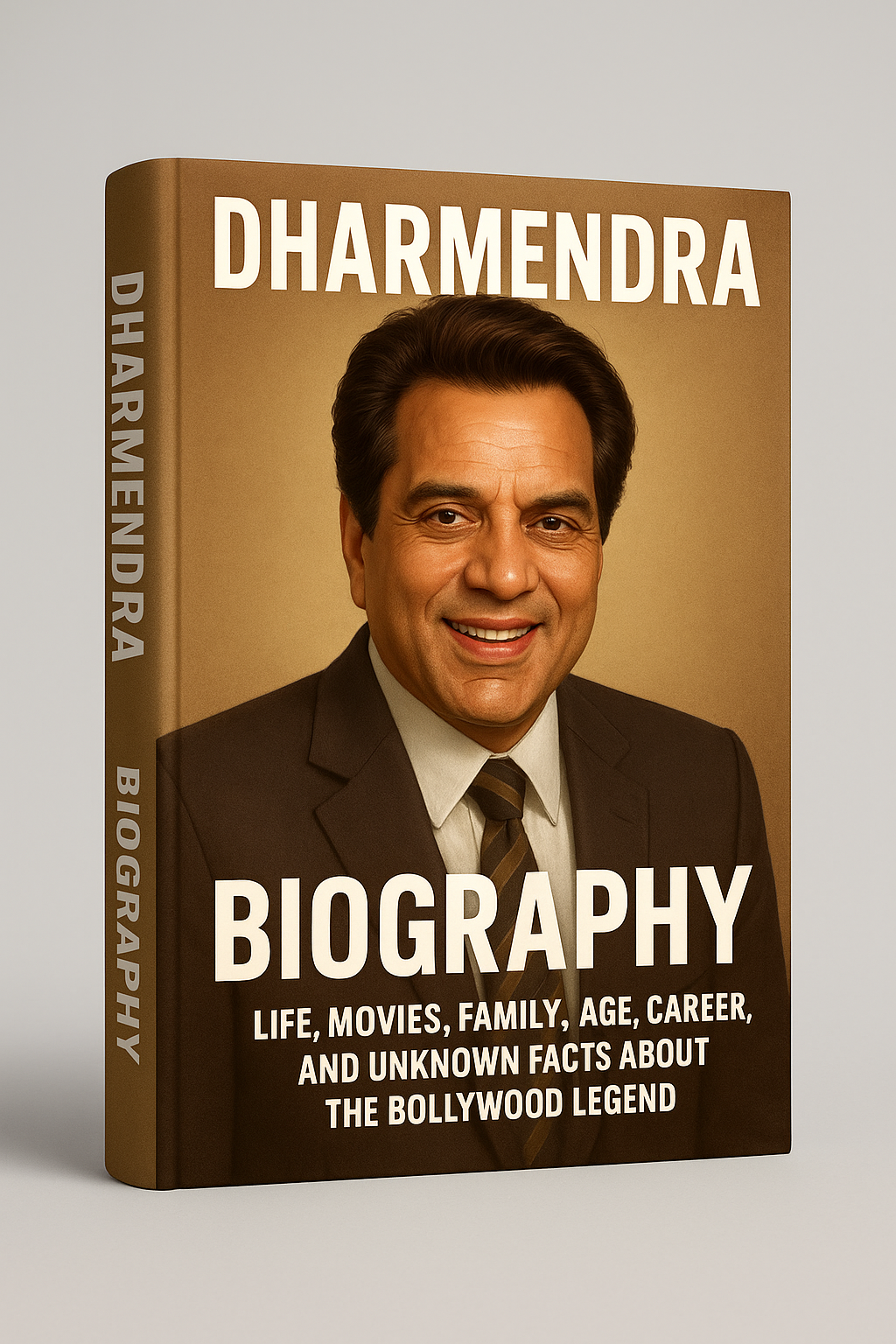
Early Life & Background
Dharmendra was born on 8 December 1935 in the village of Nasrali, Khanna tehsil, Ludhiana district (now in Punjab, India).
His father, Kewal Krishan (sometimes written Kewal Kishan) Deol, was a government school teacher; his mother was Satwant Kaur.
Growing up in a modest Punjabi family, young Dharmendra was exposed to the rural milieu of Punjab and developed a robust physical build which would later help in his “action hero” image.
He moved to Bombay (now Mumbai) in his early 20s to pursue opportunities in Hindi cinema. His break came by winning a talent hunt organised by Filmfare magazine in 1958.
Education & Early Influences
Though not extensively documented, some sources state he completed up to 12th standard in his village before shifting to Bombay.
His early influences included the strong protagonists of Hindi cinema and the larger-than-life macho persona emerging in films. He possessed a tall, well-built physique and a handsome face, which later earned him the nickname “He-Man of Bollywood”.
Early Struggles
His debut film was Dil Bhi Tera Hum Bhi Tere (1960) directed by Arjun Hingorani, but the film was unsuccessful at the box-office.
Like many actors of his time, Dharmendra underwent years of struggle: doing works in black-and-white, doing smaller roles, being typecast, waiting for his break. Those years shaped his stamina and versatility.
Rise to Stardom: The 1960s
The 1960s saw Dharmendra gradually move from a newcomer to a leading man.
Breakthrough Films
Some of his early successful films:
Ayee Milan Ki Bela (1964) — helped him gain attention.
Phool Aur Patthar (1966) — a film that established him as a star.
Seeta Aur Geeta (1972) – though early 1970s, but this film’s production began in the 60s era of his career-growth.
His performances in dramas, romances and thrillers in the 1960s showed that he was not just a pretty face but a capable actor.
Establishing the Action Hero Persona
By the late 1960s, Dharmendra was beginning to shift toward more action-oriented roles. His film Ankhen (1968) is cited as a key film.
This evolution foreshadowed his dominance in the 1970s as a star who could do action, romance and drama.
The Golden Era: 1970s & Peak Career
The 1970s represent the peak of Dharmendra’s stardom — both commercially and culturally.
Landmark Film: Sholay (1975)
One cannot talk about Dharmendra without giving due credit to Sholay. He played the role of Veeru opposite Amitabh Bachchan’s Jai. The film became a massive blockbuster and remains a cult classic in Indian cinema.
The film held the record for the highest-grossing Hindi film for 19 years.
Dharmendra’s portrayal of Veeru—lovable, brave, charismatic—cemented his superstar status.
Versatility & Box Office Consistency
He gave multiple hits in the 1970s: action dramas like Mera Gaon Mera Desh (1971), comedies like Chupke Chupke (1975), dual-role entertainers like Samadhi (1972) and more.
According to Wikipedia: “He holds the record for starring in the highest number of hit films in Hindi cinema. In 1973, he delivered eight hits.”
This shows remarkable dependability in an era when many stars flourished briefly then faded.
Nicknames & Persona
During this time his image as the action-hero with a heart became very popular. He earned the monikers:
“He-Man of Bollywood”
“Garam Dharam” (a playful version of his name)
His physicality, his style of dialogue delivery, his screen presence—all contributed to the larger-than-life aura.
Collaborations & Pairings
He worked with many leading actresses of the time: Hema Malini (who later became his wife), Asha Parekh, Sharmila Tagore, Mumtaz, Zeenat Aman. These pairings resulted in memorable romantic action dramas.
Transition, Later Career & Roles in the 1980s & 1990s
As the 1980s dawned, the Hindi film industry underwent changes: newer stars, changing audience tastes, heavier focus on action and star power. Dharmendra navigated this transition with varying degrees of success.
Action Films & Box Office in the 1980s
He starred in many action-intense films: Dharam Veer (1977), The Burning Train (1980), Hukumat (1987) etc.
As one Reddit comment noted:
“He still holds the record for delivering the most number of hit films by an actor in Hindi cinema.”
Another comment:
“Only yesteryear hero to have stardom after turning 50.. that person is none other than Dharmendra.”
This underlines that even as he aged, his popularity didn’t rapidly decline like many of his contemporaries.
Challenges & Decline
However, the early 1990s saw a slump in his career‐graph. As new stars like Shah Rukh Khan, Aamir Khan and Salman Khan rose, and audience tastes shifted, Dharmendra’s films struggled.
He gradually moved to character roles, supporting roles, and special appearances.
Notable Late Works
Some significant later films include Life in a…Metro (2007), Johnny Gaddaar (2007), Yamla Pagla Deewana (2011) (in which he starred alongside his sons).
Even into his 80s, he made cameo appearances and lent his legacy to new films; for instance Rocky Aur Rani Kii Prem Kahaani (2023) is mentioned in his notable credits.
Personal Life: Family, Relationships & Beyond
Dharmendra’s personal life, like many film‐stars, has been much discussed and remains of interest to fans and media alike.
Marriages & Children
In 1954, at the age of about 19, Dharmendra married Prakash Kaur (his childhood sweetheart from his village).
With Prakash Kaur, he has four children: sons – Sunny Deol and Bobby Deol (both popular actors) and daughters Ajeeta (sometimes “Ijeeta”) and Vijayta.
In 1980, Dharmendra married actress Hema Malini (their partnership also famously onscreen). They have two daughters: Esha Deol and Ahana Deol.
Hence, Dharmendra is a father of six children and part of the famed Deol family of Hindi cinema.
Official Records & Controversies
While his personal life remains mostly private, some legal and political issues came up during his career. For example, during his stint as Member of Parliament he was alleged to have changed his religion when marrying Hema Malini — though the matter didn’t become legally decisive.
His family dynamics — two wives, multiple children — have made for occasional media interest.
Political Career
In 2004, Dharmendra entered politics and contested the Lok Sabha elections from the Bikaner constituency in Rajasthan on a ticket of the Bharatiya Janata Party (BJP). He served as Member of Parliament from 2004 to 2009.
Though his political career was not as long or as high‐profile as his film career, it reflects his willingness to step beyond cinema.
Personality & Off-screen Presence
On screen, Dharmendra was the charismatic hero. Off-screen, he has been known for his warm nature, Punjabi roots, family-oriented approach and love for his fans and colleagues. Many anecdotes exist of his being approachable and generous. One Reddit comment recounts:
“Heard he has actually passed away.. don’t know” – though this was false. Shows how strong his mythic presence is.
Another comment:
“He still holds the record for delivering the most number of hit films by an actor in Hindi cinema.”
These reflect his enduring star‐status in public memory.
Style, Screen Persona & Impact on Hindi Cinema
The “He-Man” Image
Dharmendra’s physicality, good looks, and action‐hero potential earned him the moniker “He-Man of Bollywood”.
His swagger, punchy dialogues, and the ability to carry cavalry blockbuster films made him a bankable star.
Versatility: Romance, Drama & Comedy
Although associated with action, Dharmendra was able to do a wide range of genres:
Romantic and dramatic films in the 1960s.
Action and dacoit dramas in early 1970s.
Comedies and dual-roles (like Seeta Aur Geeta, Chupke Chupke).
This versatility helped him cross changing audience tastes and stay relevant.
Influence & Legacy
His success paved the way for future stars to balance action and romance. His presence in major films alongside Amitabh Bachchan and others during the peak of Hindi cinema helped shape how heroism was portrayed. He inspired younger actors including his own son Sunny Deol.
His record of delivering numerous hits (even at an age when many stars faded) is often cited as remarkable in Bollywood folklore.
Milestone Achievements & Awards
Awarded the Padma Bhushan (India’s third highest civilian honour) in 2012.
Received the Filmfare Lifetime Achievement Award in 1997.
Holds a record in Bollywood for number of hit films.
Notable Films & Career Highlights
Below is a curated list of some of his major films (not exhaustive) with emphasis on those that defined his career.
Year Film Why it matters
1960 Dil Bhi Tera Hum Bhi Tere His debut film.
1963 Bandini Early acclaimed performance.
1966 Phool Aur Patthar Solidified his star status.
1971 Mera Gaon Mera Desh Major hit, action/drama hero image.
1972 Seeta Aur Geeta Dual role comedy‐drama with Hema Malini.
1975 Sholay Cultural phenomenon, evergreen.
1980 The Burning Train Big-budget action film of early ‘80s.
1987 Hukumat One of his late 1980s hits.
2007 Life in a…Metro A later critically appreciated film.
2011 Yamla Pagla Deewana Shared screen with his sons.
2023 Rocky Aur Rani Kii Prem Kahaani Even in recent years, his presence is felt.
Each of these films marks some transition: from newcomer to hero, hero to superstar, superstar to legacy figure.
Challenges, Adaptations & Later Years
Navigating Industry Changes
As Bollywood moved through the 1990s and 2000s, the star system changed. Dharmendra, like many veteran actors, had to adapt by taking character roles, playing father figures, or cameo roles. In doing so, he maintained relevance rather than fading away.
Health & Ageing
Ageing is natural; Dharmendra has remained active, though less frequently on screen. As of 2025, he is 89 years old and his health has occasionally been in the news.
Legacy Projects & Family Participation
His sons Sunny and Bobby Deol followed him into films, making the Deol family a sort of film‐dynasty. Sharing screen space with them (like in Yamla Pagla Deewana) shows his willingness to pass the torch while still being active.
Legacy and Cultural Impact
Iconic Status
Dharmendra is more than just a film star—he is an icon of Hindi cinema’s golden era. His dialogues, screen persona, and style remain referenced even today. For example:
“Baap ke naam kaa sahara kamzor log lete hai” — from Jugnu (1973) — has become a popular Hindi dialogue.
Influence on Next Generation
Apart from his family, many actors look up to him for his longevity, his ability to stay relevant across decades, and his transition from hero to father figure without losing respect.
Fan Culture & Social Memory
Even today, fans celebrate his birthday, his past films are rerun, dialogues are remembered, and nostalgic lists pay tribute to his contribution. Reddit threads show how fans regard him:
“He still holds the record for delivering the most number of hit films…”
Such commentary underscores his enduring place in popular culture.
Representation of an Era
Dharmendra’s career maps with major shifts in Hindi cinema: black-and-white to colour, romance to action, superstar era to multiplex era. His trajectory helps us understand the evolution of Bollywood.
Lessons from Dharmendra’s Career for Aspiring Actors & Filmmakers
1. Versatility helps: Starting in romance and drama, moving to action and comedy. Changing with time.
2. Durability matters: Instead of being a flash in the pan, Dharmendra delivered consistent hits.
3. Work ethic and physicality: His presence, stunts, willingness to try different genres made him stand out.
4. Navigating transition: He gracefully moved from leading hero to character actor rather than resisting change.
5. Brand beyond films: His image, public persona, family brand (Deol family) helped sustain his legacy.
Conclusion
Dharmendra’s story is one of talent meeting opportunity, of evolving with the times, and of building a legacy rather than just a moment. From a village in Punjab to the studios of Bombay, from debutant to superstar, from action-hero to father figure, Dharmendra has lived many chapters of cinematic history.
He remains a symbol of resilience, adaptability, and charm in Hindi cinema.
For anyone exploring the history of Bollywood, the star system, or the 1970s revolution in Indian films, Dharmendra’s career offers valuable insights and memories. His films continue to be watched, his dialogues continue to be enjoyed, and his image remains etched in Indian pop culture.